Ear Piercing Guide
This section provides comprehensive information regarding the diverse ear piercing services available at Momentu. Should you require further details or have inquiries, do not hesitate to reach out to us via telephone or social media. Utilize the quick links below or navigate through the content for more information.
Tragus
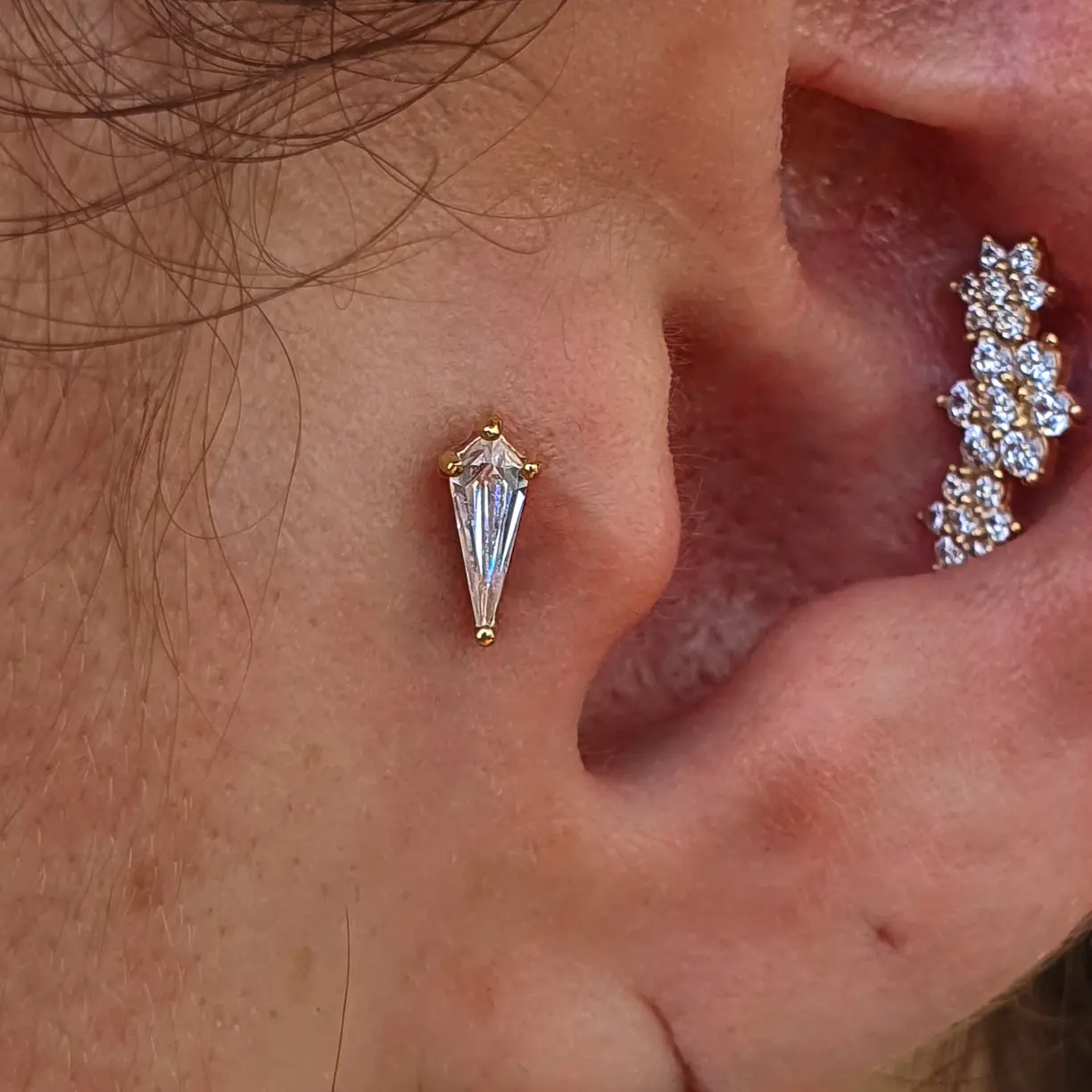
Can I ever wear earbuds or AirPods again? Fact: Yes, but only after the piercing is fully healed (6-12 months). Even then, your ability to wear them comfortably will depend on your specific anatomy and your jewellery style. Many people find that smaller earbuds or "runner's" style earbuds with flexible attachments work well, while others find the original fit is fine once healed.
Myth: Will a tragus piercing cause nerve damage or facial paralysis? Fact: False. This is a common and persistent myth. The piercing is superficial, passing only through the small piece of cartilage. The major facial nerves are located much deeper within the facial structure and "cannot be hit by a piercing needle". This myth is not based on factual anatomy.
When can I switch to a hoop? Fact: Only after the piercing is fully healed, which is 6-12 months. Cartilage heals from the outside in , so it may look healed long before it is stable. Changing to a hoop too early is a primary cause of irritation and bumps, as hoops move and rotate far more than a stud.
Will my tragus piercing interfere with wearing glasses? Fact: No. The tragus is located in front of the ear canal and does not interfere with the arms of glasses, which rest behind the ear. You may be thinking of a conch or helix piercing, which can sometimes be in the path of your glasses.
- Don't Touch It: Do not twist, turn, rub, or move the jewellery. Only touch the area with thoroughly washed hands when you are cleaning it.
- Wash Simply: Clean the piercing 2-3 times per day with a sterile saline wound wash (0.9% sodium chloride only).
- Rinse in Shower: Let clean, warm water run over the piercing in the shower to rinse away saline and any softened "crusties."
- Keep It Dry: After cleaning, gently pat the area dry with a clean, disposable paper towel or sterile non-woven gauze. Do not use cloth towels.
- Keep It Out of Water: Avoid submerging the piercing in pools, hot tubs, baths, or lakes during the healing process.
- Don't Sleep On It: Sleeping on your piercing puts pressure on it, which can cause irritation bumps and "shift the angle". Sleep on the opposite side, or use a travel pillow with a hole in the centre.
- Return for Downsizing: This is mandatory. You must return for your downsize appointment around 4-8 weeks.
- CRITICAL: No In-Ear Headphones: You cannot use in-ear headphones, earbuds, or AirPods in the pierced ear for the entire 6-12 month healing period. The pressure, friction, and bacteria from the earbud will cause severe irritation, migration, and can lead to healing failure. You must use over-ear headphones, and be careful that they do not press on the piercing.
- Anatomy Dependent (But Usually Possible): This piercing is placed on the tragus, which is the small flap of cartilage directly in front of the ear canal. While most people have suitable anatomy, an in-person assessment is required. Some individuals have a tragus that is "too shallow or too thin" to safely support jewellery.
- Mandatory Downsizing: This is a non-negotiable step for a successful tragus. You will be pierced with a longer labret stud to accommodate initial swelling. You must return to the studio in 4-8 weeks to have this post swapped for a shorter, fitted one. Failing to do so will cause the long post to snag and "shift the angle" of the piercing, which is often permanent.
- Long Healing Time: This is a cartilage piercing, not soft tissue. It takes a full 6-12 months to completely heal. It may feel "healed" much earlier, but the internal tissue is still fragile. Do not stop aftercare or change to a hoop until it is fully mature.
- Jewellery: This piercing is performed with an implant-grade titanium flatback labret stud. The flat back rests flush against the side of your face, providing essential comfort and stability.
Conch
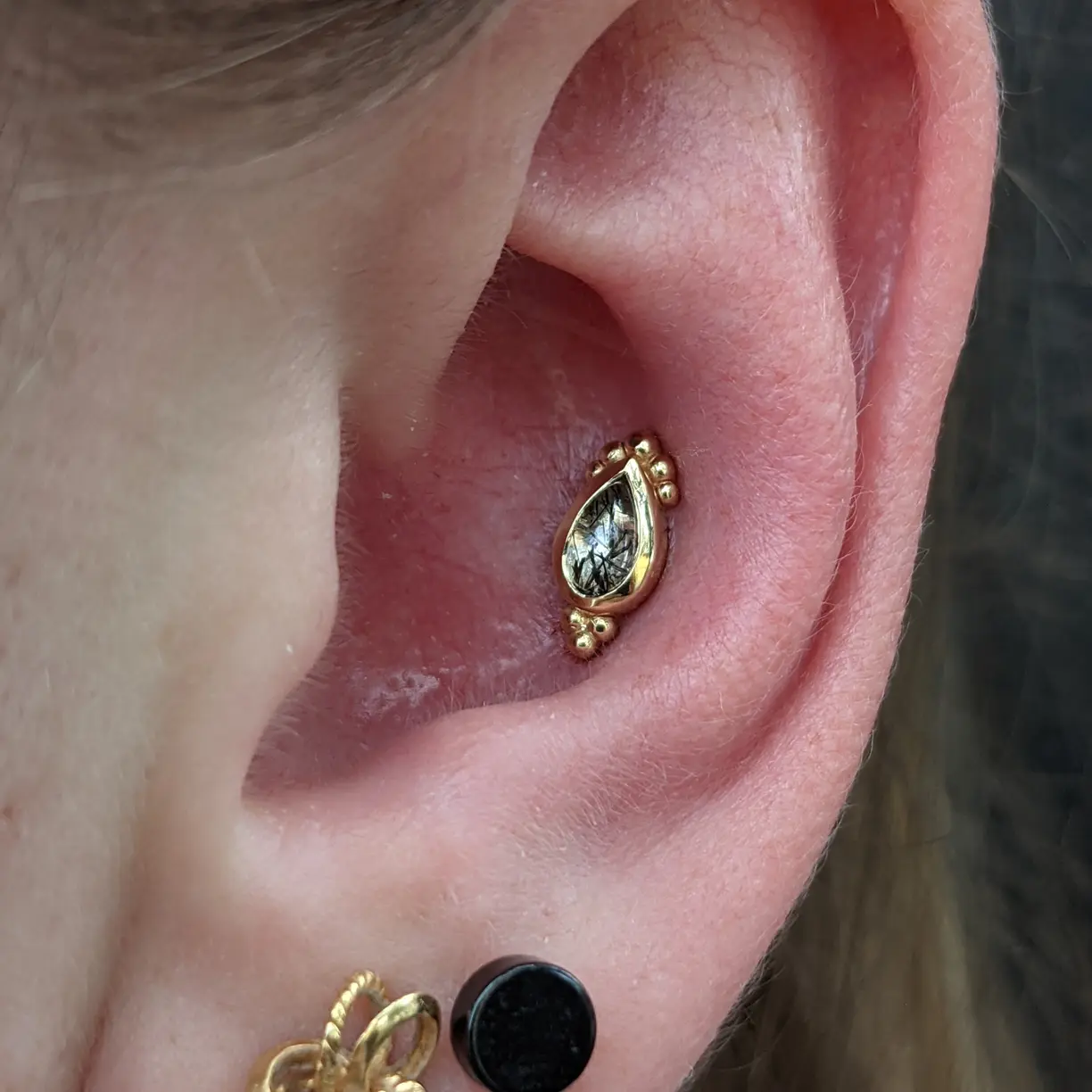
Will a conch piercing help with my migraines or anxiety? Fact: No. This is a popular myth, but there is no scientific or medical evidence to support this claim. The American Migraine Foundation does not endorse it. Any perceived benefit is due to the placebo effect. We provide this piercing as a beautiful piece of body art, not as a medical treatment.
Can I wear earbuds, AirPods, or headphones with a conch piercing? Fact: You cannot wear in-ear devices (earbuds, AirPods, stethoscopes) in the healing ear for the full 6-12 month healing period. The pressure and bacteria will cause complications. Over-ear headphones are acceptable only if the ear cup is large enough to sit completely around the ear and not put pressure on the conch itself.
Why can't I be pierced with a hoop? Fact: We start with a flat-back stud because it provides the most stable, low-movement environment for the piercing to heal. Hoops (rings) move, rotate, and snag easily, which drags bacteria into the healing channel and causes irritation, piercing bumps, and a much longer, more difficult heal. Your health and safety are our priority. You are free to wear a hoop after the piercing is 100% healed (6-12 months).
Why is downsizing so important? It sounds like an extra cost. Fact: Downsizing is a non-negotiable part of the healing process and the number one way to ensure a successful outcome. The initial bar is long to allow for swelling. Once that swelling subsides (around 6-10 weeks), that extra length becomes a liability. It snags on hair, pillows, and masks, which causes physical trauma to the piercing. The downsize (a simple, quick change to a shorter bar) removes this risk and is the most important step you can take for your piercing.
Will this piercing leave a huge scar if I take it out? Fact: No. A properly healed and retired conch piercing will leave a tiny, faint dot, similar to a pock-mark or small acne scar (known as an atrophic scar). It is typically not noticeable. Large, raised scars (hypertrophic or keloid) are not the norm; they are the result of complications during healing, such as persistent irritation, infection, or a genetic predisposition.
- Don't Touch It: This is the most important rule. Do not twist, turn, rub, or move the jewellery. Only touch the area with thoroughly washed hands when you are cleaning it.
- Wash Simply: Clean the piercing 2-3 times per day with a sterile saline wound wash (0.9% sodium chloride only).
- Rinse in Shower: Let clean, warm water run over the piercing in the shower to rinse away saline and any softened "crusties".
- Keep It Dry: After cleaning, gently pat the area dry with a clean, disposable paper towel or sterile non-woven gauze. Do not use cloth towels, which can snag jewellery and harbour bacteria.
- Keep It Out of Water: Avoid submerging the piercing in pools, hot tubs, baths, or lakes during the healing process.
- Don't Sleep On It: Sleeping on your new piercing will cause irritation, bumps, and can shift the angle of the piercing. Sleep on the opposite side, or use a travel pillow with a hole in the centre to suspend your ear.
- Mind Your Mask and Glasses: Be very careful when putting on or removing face masks, as the straps can snag the jewellery. Similarly, ensure the arms of your glasses do not rest on the piercing.
- Return for Your Downsize: This is a mandatory check-up. Returning for your downsize appointment (around 6-10 weeks) is essential for a stable and happy heal.
- Anatomy is Key: The "conch" is a large area. We typically pierce the Inner Conch (the bowl of the ear), which is suitable for almost everyone. The Outer Conch (or "contraconch") is a rarer piercing on the flat ridge above, which is extremely anatomy-dependent. An in-person assessment is required to confirm your ideal placement.
- Starts With a Stud (Not a Hoop): We exclusively use a flat-back labret stud for your initial conch piercing. This is non-negotiable for healing. Hoops cause movement, snagging, and irritation, leading to bumps and complications. You may switch to a hoop only after the piercing is fully healed (6-12 months).
- Mandatory Downsizing at 6-10 Weeks: This is the most critical step for a successful heal. You must return to the studio between 6 and 10 weeks post-piercing to have the initial long bar replaced with a shorter, fitted bar. Failing to do so is a primary cause of snagging, irritation, and healing complications.
- No In-Ear Headphones During Healing: You cannot use in-ear headphones, earbuds, or AirPods in the pierced ear for the entire 6-12 month healing period. The pressure and bacteria will cause severe irritation and can delay or prevent healing. Over-ear headphones are fine, if they do not press on the piercing.
- Fun Fact: The conch piercing gets its name from its location in the "concha"—the shell-shaped bowl of the ear, which resembles a conch shell.
Earlobe
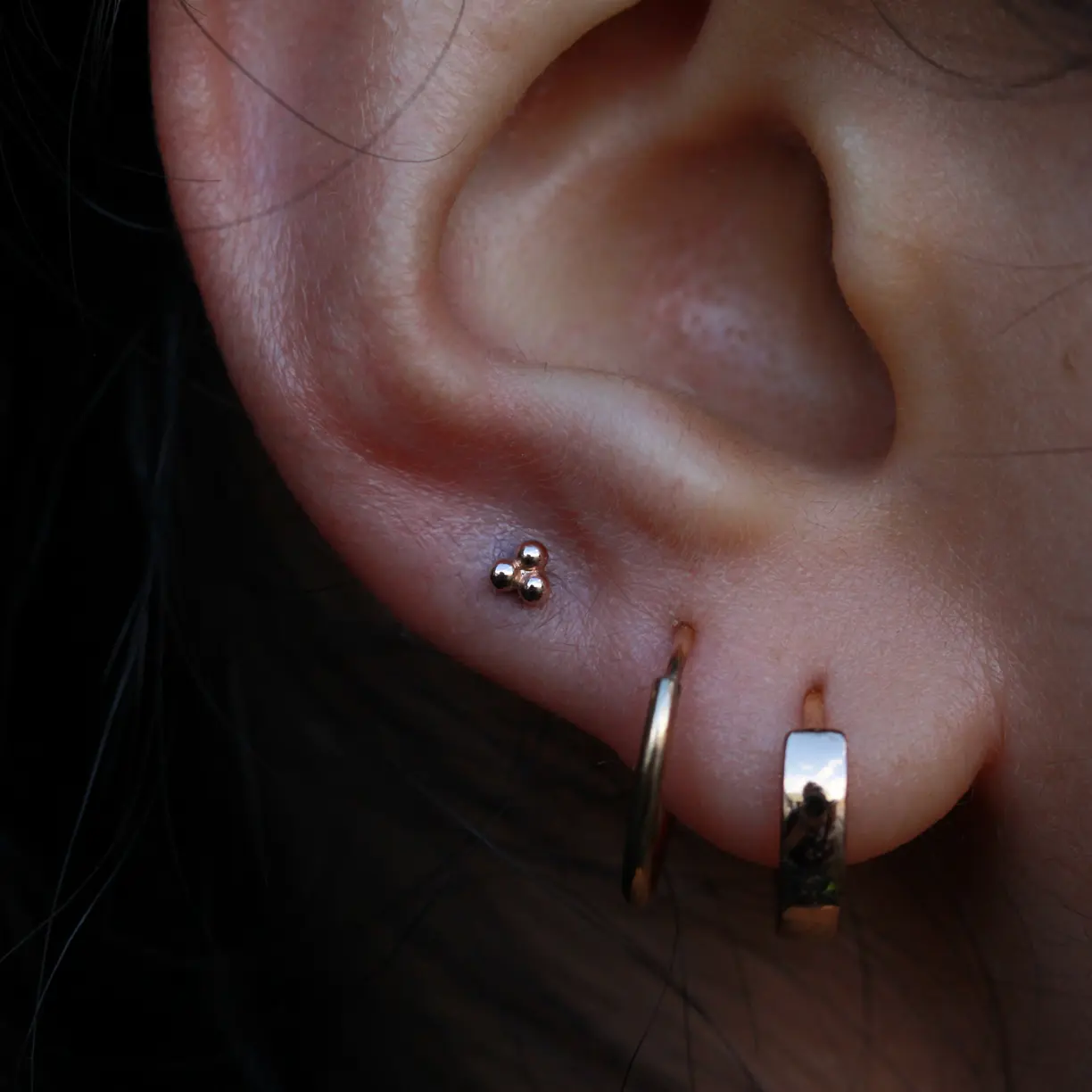
Myth: Aren't earlobes supposed to be pierced with a gun? Fact: False. This is a dangerous and outdated misconception. Piercing guns are reusable and "cannot be properly sterilized" in a medical-grade autoclave, creating a significant risk of transmitting blood-borne pathogens. Furthermore, guns use "blunt force trauma" to force a stud through the skin, which can shatter cartilage (if used incorrectly) and "tears" soft tissue, leading to excessive damage and healing complications. Professional studios only use a "more precise" , single-use, sterile needle, which is gentler on the tissue and clinically safer.
Myth: You have to twist the earring every day so the skin doesn't grow onto it. Fact: This is false and is the most common cause of healing problems. Twisting or rotating the jewellery "is not necessary" and "causes more harm than good". It introduces bacteria from your hands and damages the delicate, healing fistula, leading to irritation, bumps, and infection. Your skin "will not grow onto the jewelry". The "crusties" (dried lymph) are a normal part of healing and should be gently rinsed away with saline or water, not picked or twisted off.
When can I change my earring? Fact: You must wait until the piercing is fully healed, which takes 3-6 months. The initial 6-8 week period is only the start of the process. Piercings heal from the "outside in," meaning that while it may look and feel fine on the outside, the internal tissue is still fragile. Changing the jewellery too soon can easily damage this new tissue, forcing you to restart the healing process.
Can I get multiple lobe piercings at once? Fact: Yes, it is very common for clients to get two or three lobe piercings in one sitting. However, be aware that healing multiple piercings simultaneously requires more diligence and puts more strain on your body. We generally recommend piercing only one ear at a time if you are a side sleeper, as you cannot sleep on a healing piercing. We can discuss your goals during your consultation.
- Don't Touch It: This is the most important rule. Do not twist, turn, rub, or move the jewellery. This does not help healing and only introduces bacteria, which can cause infection. Only touch the area with thoroughly washed hands when you are cleaning it.
- Wash Simply: Clean the piercing 2-3 times per day with a sterile saline wound wash (must contain 0.9% sodium chloride only).
- Rinse in Shower: Let clean, warm water run over the piercing in the shower to rinse away saline and any softened "crusties" (dried lymph fluid).
- Keep It Dry: After cleaning, gently pat the area dry with a clean, disposable paper towel or sterile non-woven gauze. Do not use cloth towels, which can snag jewellery and harbour bacteria.
- Keep It Clear: Avoid all makeup, lotions, cosmetics, and hairsprays on or near the piercing until it is fully healed.
- Keep It Out of Water: Avoid submerging the piercing in pools, hot tubs, baths, or lakes during the initial healing process, as these bodies of water can harbour bacteria.
- Check Your Bedding: Change your pillowcases frequently to maintain a clean healing environment.
- Quick Initial Healing, Longer Full Healing: While the earlobe is the fastest-healing piercing, there is a difference between the initial 6-8 week healing period and the full healing time. The internal fistula (the tube of tissue) takes a full 3-6 months to become robust and stable. You must not change your jewellery or leave it empty during this entire period.
- Studs First, Not Hoops: We perform all initial lobe piercings with an implant-grade titanium flatback labret stud. This style is stable, comfortable, and promotes optimal healing. Hoops can only be safely worn after the full 3-6 month healing period is complete, as they move too much and can irritate a new piercing.
- Needles, Not Piercing Guns: This studio exclusively uses single-use, sterile, hollow needles. Piercing guns are unsafe for several reasons: they cannot be properly sterilised in an autoclave, creating an infection risk , and they operate by "blunt force trauma". This tears the tissue, which can cause damage, complications, and a longer, more difficult healing process. A needle is clinically safer and gentler on the body.
- Aftercare is Still Mandatory: Because they are so common, many people assume lobe piercings require no care. This is incorrect. They are an open wound and require consistent, gentle aftercare to prevent infection and complications.
- Fun Fact: The Oldest Piercing: Earlobe piercing is one of the oldest known forms of body modification. Evidence of pierced ears dates back over 5,000 years, most famously on the mummified remains of Ötzi the Iceman. Ancient Egyptian pharaohs, including King Tutankhamen, also had pierced lobes, which were seen as a symbol of status.
Helix

- What is this bump on my new flat piercing? Is it a keloid? Fact: It is extremely unlikely to be a keloid. Keloids are a rare, genetic scarring condition where scar tissue grows excessively beyond the original wound. What you are almost certainly seeing is an "irritation bump" (hypertrophic scar). These are very common with cartilage piercings and are a symptom of irritation. They are typically caused by being slept on , snagged , or from a jewellery post that is too long. The solution is to identify and remove the source of irritation and, most importantly, return for your downsizing appointment.
- Why is downsizing so important for this piercing? Fact: Downsizing is the most critical step you can take to ensure your piercing heals correctly. The initial long bar is a temporary piece used to accommodate swelling. Once that swelling subsides, this long bar becomes a liability. It is far more likely to be snagged on hair and clothing , and the excess length allows the piercing to "tilt" or migrate as it heals. This results in a permanently crooked angle that cannot be fixed and may require the piercing to be retired. Replacing it with a snug-fitting post at 4-8 weeks prevents this.
- Can I get my flat pierced with a hoop? Fact: No. Reputable studios will not pierce a flat with a hoop. A flat-back stud provides the stability needed for the 6-12 month healing process. A hoop's curved shape and constant rotation introduce movement and pressure that will irritate the piercing, leading to bumps and preventing it from healing. You may switch to a hoop only after the piercing is fully healed (6-12 months) and has been confirmed by a professional piercer.
- Can I wear earbuds or headphones while my flat piercing is healing? Fact: It depends on the type. In-ear headphones (like AirPods or earbuds) are typically fine, as they sit in the ear canal and do not touch the flat piercing area. Over-ear or on-ear headphones are a significant risk. They create pressure, warmth, and moisture on the healing piercing, which can cause severe irritation, bumps, and delay healing. We advise against using over-ear headphones on the pierced side for the full healing period.
- What happens if I accidentally sleep on it? Fact: Sleeping on a healing cartilage piercing is the most common cause of complications. The constant pressure can lead to persistent irritation bumps and can permanently change the angle of the piercing. This angle migration is irreversible. To prevent this, you must sleep on your opposite side. If you are a side-sleeper, use a travel pillow (or "donut" pillow) and place your ear in the hole to avoid any contact or pressure.
- Don't Touch It: Never twist, turn, or move your jewellery. This is the most common cause of irritation bumps. Only touch the area with thoroughly washed hands when cleaning.
- Wash Simply: Clean 2-3 times daily with a sterile saline wound wash (must contain 0.9% sodium chloride only). Spray the front and back, let it soak, and do not manually move the jewellery.
- Rinse in Shower: Let clean, warm water run over the piercing to rinse away saline and any softened "crusties".
- Keep It Dry: Gently pat the area dry with a fresh, disposable paper towel or sterile non-woven gauze. Cloth towels harbour bacteria and will snag the jewellery.
- Keep It Out of Water: Avoid submerging the piercing in any body of water (pools, hot tubs, baths, lakes, oceans) for the entire healing period.
- Don't Sleep On It: This is critical. Sleeping on your flat piercing will cause pressure, leading to irritation bumps and potentially causing the piercing to heal at a permanent, crooked angle. Use a travel pillow with a hole in the centre to suspend your ear.
- Return for Your Mandatory Downsize: You must return for your 4-8 week check-up to have your initial long post replaced with a shorter one. This step is essential for healthy, long-term healing.
- Beware of Snags: Be extremely careful when brushing your hair , pulling clothing over your head , wearing spectacles , and using face masks.
- Anatomy is Key for Placement: While most individuals have suitable anatomy for a flat piercing , the placement is highly customised. The broad, flat plane of the upper ear has unique ridges and valleys that will determine where a larger piece of jewellery will sit flat. An in-person consultation is required to map your specific placement.
- Studs Only for Healing: This piercing must be performed with a flat-back labret stud. It cannot be healed with a hoop. Hoops, rings, or curved jewellery cause excessive movement and pressure, which leads to irritation, bumps, and healing failure.
- Downsizing is Mandatory: You must return to the studio in 4-8 weeks for a mandatory check-up and "downsize". Your initial post is extra long to allow for swelling. Leaving this long post in is the primary cause of snagging, irritation bumps, and the piercing healing at a permanent, crooked angle.
- High Snagging Risk: The flat, exposed location is highly prone to being snagged by hair, clothing, spectacle arms, and face masks. You must be extremely mindful of these items during the entire 6-12 month healing period.

Industrial

I was told I don't have the right anatomy for an industrial piercing. What does that mean? This is a very common and important question, as this piercing is 100% dependent on your ear's anatomy. A successful industrial piercing requires two specific anatomical features. First, a prominent, well-defined outer cartilage ridge (helix) to safely anchor the jewellery. Second, and just as important, the inner 'flat' of your ear (the scapha) must not protrude, or must be flat enough for the bar to pass over it. The barbell must be able to 'float' over your inner ear flat without touching or pressing on it. If your anatomy causes the bar to press on the cartilage, it will create constant pressure, leading to painful bumps, migration, and the piercing will never heal. Our piercers will only perform this piercing if it can be done safely.
Can I heal an industrial with two separate studs and connect them with a bar later? No. This is a common myth, and attempting this is a primary reason many industrial piercings fail. An industrial piercing requires two holes that heal in perfect, parallel alignment. To achieve this, it must be pierced and healed with a single, straight barbell. This bar acts as a guide, locking the two piercings in place as they form a mature fistula. If healed with two separate studs, the piercings will inevitably shift and heal at their own individual angles. It is then virtually impossible to 'connect' them with a straight bar without causing massive, constant pressure, which leads to irritation bumps, pain, and rejection.
Can I wear my glasses or headphones while my industrial is healing? This is a major practical consideration. For headphones, you cannot wear over-the-ear headphones for the full 9-12 month healing period. The pressure will cause severe irritation and can lead to failure. In-ear earbuds are generally fine as long as they do not touch the piercing. Glasses are a significant challenge. The arms of most frames can hit, rub, or rest against the barbell, causing constant irritation that can lead to bumps and prevent healing. You must bring your primary pair of glasses with you to your consultation. We need to assess where they sit. We may be able to adjust the piercing's placement, or you may need to commit to wearing contact lenses or thinner, wire-frame glasses during the healing period.
My industrial has a 'bump' on it. Is it infected? It is most likely an 'irritation bump,' not an infection. Industrials are famous for developing these bumps. An infection would involve symptoms like yellow or green pus, a foul smell, spreading redness, and significant heat. An irritation bump (often a form of hypertrophic scarring) is a small, localized bump of tissue right next to the piercing hole. These bumps are your body's response to trauma or irritation. The most common causes are: 1) Sleeping on it , 2) Snagging it with hair, glasses, or clothing , or 3) Failing to downsize your initial long barbell. The bump will only go away when the source of irritation is removed. Stop sleeping on it, be extra careful, and if you haven't been downsized, book an appointment immediately.
What are the signs my piercing is rejecting? Rejection is very different from irritation. An irritation bump is a temporary problem. Rejection is your body actively and permanently pushing the jewellery out of your skin, like a splinter. The signs of rejection are slow and gradual. Look for:
- The skin between the two piercing holes getting thinner or more transparent.
- Seeing more of the barbell between the holes than you used to.
- The piercing holes themselves appearing to get larger.
- The jewellery hanging or drooping differently than it used to. If you notice these signs, come into the studio immediately. Rejection is not reversible, and we will need to remove the jewellery to prevent further skin damage and minimize scarring.
- Don't Touch It: This is the most important rule. Do not twist, turn, rub, or move the jewellery. Only touch the area with thoroughly washed hands when you are cleaning it.
- Wash Simply: Clean the piercing 2-3 times per day with a sterile saline wound wash (0.9% sodium chloride only). Spray both entry points and the bar, and allow the solution to soak in.
- Rinse in Shower: Let clean, warm water run over the piercing in the shower to rinse away saline and any softened "crusties" (dried lymph fluid).
- Keep It Dry: After cleaning, gently pat the area dry with a clean, disposable paper towel or sterile non-woven gauze. Do not use cloth towels, which can snag jewellery and harbour bacteria.
- Keep It Out of Water: Avoid submerging the piercing in pools, hot tubs, baths, or lakes during the entire healing process.
- Don't Sleep On It: This is the most common reason industrial piercings fail. You must sleep on the opposite side. If you are a side-sleeper, use a travel "donut" pillow and place your ear in the hole to keep it free from any pressure. This is required for the full 9-12 month healing period.
- Protect From Snagging: Be extremely careful when brushing hair (tie long hair back), pulling clothing over your head, and taking glasses on and off. The arms of glasses can hit or press on the jewellery, causing significant irritation. Over-ear headphones are forbidden.
- Return for Your Mandatory Downsize: As noted above, you must return for your downsize appointment. This is a critical part of the healing process to prevent complications.
- Strictly Anatomy-Dependent: This piercing is 100% dependent on your ear's unique shape. A successful industrial requires two specific features: a defined outer cartilage ridge (helix) to support the jewellery, and an inner ear 'flat' (scapha) that does not protrude. The barbell must 'float' over your inner cartilage without pressing on it. An in-person anatomical assessment is mandatory.
- A Long and Difficult Healing Project: Expect a healing time of 9 to 12 months, and sometimes longer. This is not one piercing, but two separate cartilage piercings that must heal in perfect alignment while connected by a rigid bar. This "dual-wound" system is delicate and requires patience and consistent care for the entire healing period.
- High Risk of Snagging & Lifestyle Conflicts: The exposed barbell is extremely prone to snagging on hair, towels, and clothing. You cannot sleep on the pierced side for the entire 9-12 month healing period. Over-ear headphones are forbidden, and wearing glasses can cause significant irritation. This piercing requires a conscious change to your daily habits.
- Mandatory Downsize Appointment: You will be pierced with a longer barbell to accommodate initial swelling. This extra length is a liability after swelling subsides. Returning for a "downsize" (typically 4-8 weeks) to have a shorter, fitted barbell inserted is not optional. This is the single most important step to prevent snagging, irritation bumps, and the shifting of the piercing's angle.
- Fun Fact: The industrial piercing is a modern invention, first introduced in 1992 by legendary piercer Erik Dakota (who also named the daith and rook piercings). It was originally called the "industrial ear project."
Faux Rook
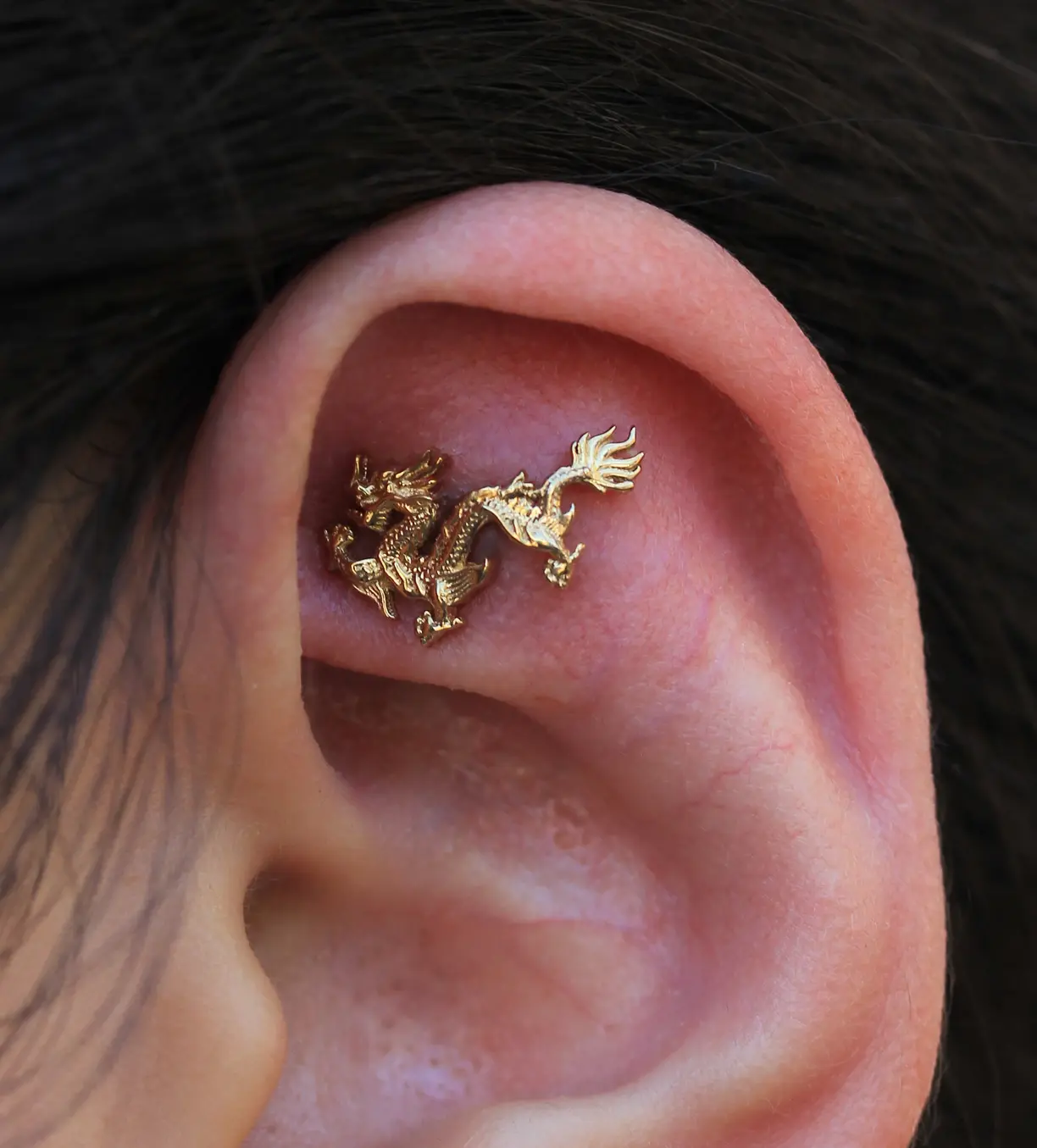
Is this a 'fake' rook? Why not get a 'real' one? Fact: It's not "fake"—it's a curated flat helix piercing. A "true" rook piercing passes through a specific ridge of cartilage inside the ear (the anti-helix). Many people do not have a prominent enough ridge for this piercing to be viable. The faux rook is a brilliant and creative alternative that provides the same aesthetic, often with more exciting jewellery options, for clients who are not candidates for a true rook.
Can I wear earbuds or AirPods with a faux rook piercing? Fact: Yes. Unlike a daith piercing, which sits in the bowl of the ear and blocks the ear canal , the faux rook is on the flat, outer part of the ear and should not interfere with in-ear headphones. However, you must be cautious with over-ear headphones, as the pressure from the cuff can press on the piercing and cause significant irritation.
How do I stop my face mask from catching on it? Fact: This is the most common challenge for this piercing. We strongly recommend purchasing "ear-saver" mask straps that hook behind your head, avoiding your ears completely. If you must use standard ear loops, be extremely careful, putting the mask on and taking it off very slowly and unhooking the non-pierced side first.
Will it leave a huge, ugly scar if I take it out? Fact: No. This is an exaggeration, similar to myths about eyebrow piercings. A well-healed cartilage piercing will leave a very small, faint dot that is "hardly noticeable". Significant, raised, or "bad" scars are not the norm; they are the result of complications like severe infection, persistent trauma, or allowing an irritation bump to become permanent.
Will this piercing cause nerve damage or hearing loss? Fact: No. This is a common myth, much like the myth that eyebrow piercings cause facial paralysis. The piercing is superficial, passing only through the ear cartilage. It does not interact with the ear canal, the eardrum, or the deep nerves responsible for hearing or facial function.
- Don't Touch It: This is the most important rule. Do not twist, turn, rub, or move the jewellery. Only touch the area with thoroughly washed hands when you are cleaning it.
- Wash Simply: Clean the piercing 2-3 times per day with a sterile saline wound wash (must contain 0.9% sodium chloride only). Spray the front and back of the piercing, letting the solution soak for a minute to soften any "crusties" (dried lymph fluid).
- Rinse in Shower: Let clean, warm water run over the piercing at the end of your shower to rinse away saline and any softened crusties. Do not use a direct, high-pressure spray.
- Keep It Dry: After cleaning or showering, gently pat the area dry with a clean, disposable paper towel or sterile non-woven gauze. Do not use cloth towels, which can snag the jewellery and harbour bacteria.
- Avoid All Trauma: Be hyper-vigilant about face masks, glasses, and headphones. When removing a mask, unhook it from the non-pierced ear first, then carefully slide it from behind the new piercing. Consider using an "ear-saver" mask strap.
- Keep It Out of Water: Avoid submerging the piercing in pools, hot tubs, baths, or lakes during the entire healing process, as these can introduce bacteria.
- Don't Sleep On It: Sleeping on the piercing will cause complications. We recommend using a travel pillow and placing your ear in the centre hole, or sleeping exclusively on the opposite side.
- Return for Your Downsize: This is mandatory. Once your initial swelling subsides (typically 4-8 weeks), you must return for your piercer to install a shorter, fitted labret post. This step is critical to prevent snagging and angling.
- Anatomy for Aesthetics: This is not a "true" rook piercing. It is a flat helix piercing that is strategically placed to mimic the aesthetic of a rook piercing. This is an excellent, modern alternative for clients who desire the "rook" look but whose anatomy lacks the specific, pronounced cartilage ridge required for a true rook piercing.
- High Snagging Risk: This piercing's location on the flat, outer-ear cartilage makes it extremely vulnerable to snagging. You must be hyper-vigilant with hair, glasses, over-ear headphones, and especially the ear loops of face masks.
- Mandatory Downsizing: You will be pierced with a longer labret stud to accommodate initial swelling. Returning to the studio to have this bar "downsized" to a shorter, fitted post (typically 4-8 weeks after piercing) is a non-negotiable step. Failing to downsize is a primary cause of irritation, migration, and healing complications.
- Long Healing Time: This is a cartilage piercing and requires approximately 6 to 12 months for the internal tissue (fistula) to fully mature. It may feel healed long before this, but you must continue consistent aftercare and avoid trauma for the entire healing period.
- No Sleeping On It: You cannot sleep on the pierced ear for the full healing timeline. This pressure can cause severe irritation, "irritation bumps," and can permanently shift the angle of the piercing, causing it to heal crookedly.
- Fun Fact: The "Faux Rook" is a testament to modern piercer ingenuity. It was developed as a creative, anatomy-driven solution to give clients the aesthetic they desired, proving that placement and jewellery curation are a true art form.
Flat
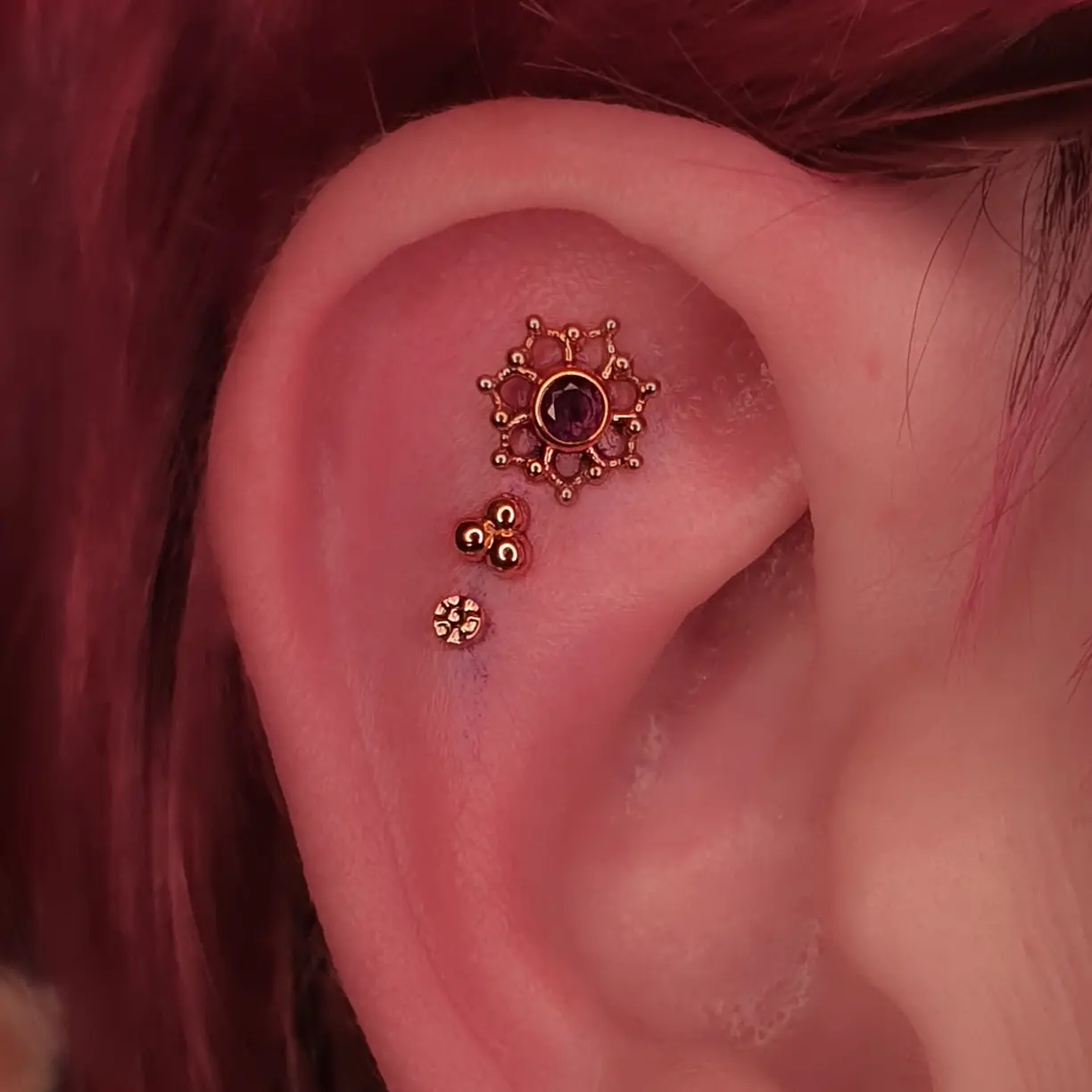
- What is this bump on my new flat piercing? Is it a keloid? Fact: It is extremely unlikely to be a keloid. Keloids are a rare, genetic scarring condition where scar tissue grows excessively beyond the original wound. What you are almost certainly seeing is an "irritation bump" (hypertrophic scar). These are very common with cartilage piercings and are a symptom of irritation. They are typically caused by being slept on , snagged , or from a jewellery post that is too long. The solution is to identify and remove the source of irritation and, most importantly, return for your downsizing appointment.
- Why is downsizing so important for this piercing? Fact: Downsizing is the most critical step you can take to ensure your piercing heals correctly. The initial long bar is a temporary piece used to accommodate swelling. Once that swelling subsides, this long bar becomes a liability. It is far more likely to be snagged on hair and clothing , and the excess length allows the piercing to "tilt" or migrate as it heals. This results in a permanently crooked angle that cannot be fixed and may require the piercing to be retired. Replacing it with a snug-fitting post at 4-8 weeks prevents this.
- Can I get my flat pierced with a hoop? Fact: No. Reputable studios will not pierce a flat with a hoop. A flat-back stud provides the stability needed for the 6-12 month healing process. A hoop's curved shape and constant rotation introduce movement and pressure that will irritate the piercing, leading to bumps and preventing it from healing. You may switch to a hoop only after the piercing is fully healed (6-12 months) and has been confirmed by a professional piercer.
- Can I wear earbuds or headphones while my flat piercing is healing? Fact: It depends on the type. In-ear headphones (like AirPods or earbuds) are typically fine, as they sit in the ear canal and do not touch the flat piercing area. Over-ear or on-ear headphones are a significant risk. They create pressure, warmth, and moisture on the healing piercing, which can cause severe irritation, bumps, and delay healing. We advise against using over-ear headphones on the pierced side for the full healing period.
- What happens if I accidentally sleep on it? Fact: Sleeping on a healing cartilage piercing is the most common cause of complications. The constant pressure can lead to persistent irritation bumps and can permanently change the angle of the piercing. This angle migration is irreversible. To prevent this, you must sleep on your opposite side. If you are a side-sleeper, use a travel pillow (or "donut" pillow) and place your ear in the hole to avoid any contact or pressure.
- Don't Touch It: Never twist, turn, or move your jewellery. This is the most common cause of irritation bumps. Only touch the area with thoroughly washed hands when cleaning.
- Wash Simply: Clean 2-3 times daily with a sterile saline wound wash (must contain 0.9% sodium chloride only). Spray the front and back, let it soak, and do not manually move the jewellery.
- Rinse in Shower: Let clean, warm water run over the piercing to rinse away saline and any softened "crusties".
- Keep It Dry: Gently pat the area dry with a fresh, disposable paper towel or sterile non-woven gauze. Cloth towels harbour bacteria and will snag the jewellery.
- Keep It Out of Water: Avoid submerging the piercing in any body of water (pools, hot tubs, baths, lakes, oceans) for the entire healing period.
- Don't Sleep On It: This is critical. Sleeping on your flat piercing will cause pressure, leading to irritation bumps and potentially causing the piercing to heal at a permanent, crooked angle. Use a travel pillow with a hole in the centre to suspend your ear.
- Return for Your Mandatory Downsize: You must return for your 4-8 week check-up to have your initial long post replaced with a shorter one. This step is essential for healthy, long-term healing.
- Beware of Snags: Be extremely careful when brushing your hair , pulling clothing over your head , wearing spectacles , and using face masks.
- Anatomy is Key for Placement: While most individuals have suitable anatomy for a flat piercing , the placement is highly customised. The broad, flat plane of the upper ear has unique ridges and valleys that will determine where a larger piece of jewellery will sit flat. An in-person consultation is required to map your specific placement.
- Studs Only for Healing: This piercing must be performed with a flat-back labret stud. It cannot be healed with a hoop. Hoops, rings, or curved jewellery cause excessive movement and pressure, which leads to irritation, bumps, and healing failure.
- Downsizing is Mandatory: You must return to the studio in 4-8 weeks for a mandatory check-up and "downsize". Your initial post is extra long to allow for swelling. Leaving this long post in is the primary cause of snagging, irritation bumps, and the piercing healing at a permanent, crooked angle.
- High Snagging Risk: The flat, exposed location is highly prone to being snagged by hair, clothing, spectacle arms, and face masks. You must be extremely mindful of these items during the entire 6-12 month healing period.
- Fun Fact (The "Curated Ear" Centrepiece): The flat piercing is a modern trend. Its popularity exploded with the "curated ear" movement, as the broad, open space is perfect for acting as a large statement centrepiece or for creating "constellations" with smaller studs.
Forward Helix

- Does a forward helix piercing help with muscle tension or wrinkles? Fact: No. This is a common myth, similar to the disproven claim that daith piercings help migraines. There is no scientific or medical evidence to support the idea that a forward helix piercing provides any acupuncture-like benefits for muscle tension, blood circulation, or wrinkles. Any perceived benefit is due to the placebo effect. This is a cosmetic piercing, not a medical procedure.
- Can I wear headphones, glasses, or face masks with a new forward helix? Headphones: In-ear buds (like AirPods) are usually fine as they do not touch the piercing area. However, you must avoid all over-ear or on-ear headphones for the entire healing period. The pressure from the earcups will cause severe irritation, bumps, and can lead to migration. Glasses: This can be challenging. We require you to bring your glasses to your appointment. Our piercer will assess your anatomy with your glasses on and mark a placement that minimises contact. You must still be extremely careful when taking them on and off. Face Masks: This is a primary source of irritation. Be very slow and careful when removing your mask to prevent the strap from catching. Masks that tie behind the head are a much safer alternative during healing.
- Why can't I get pierced with a hoop? A hoop is not suitable for an initial forward helix piercing. Hoops have a natural curvature that puts constant pressure on the straight channel of a new piercing, and their ability to rotate causes excessive trauma and irritation. We use a flat-back labret stud, which provides stability and the lowest possible profile to avoid snagging. Once fully healed (after 6-12 months), you can be professionally fitted for a hoop.
- I have a bump on my piercing! Is it a keloid? It is extremely unlikely to be a keloid. Keloids are a specific genetic scarring condition where scar tissue grows excessively beyond the original wound. What you are almost certainly seeing is an irritation bump (a hypertrophic scar), which is very common with cartilage piercings. This bump is a symptom of irritation, likely from being slept on, snagged by a mask, or hit. The solution is to identify and remove the irritant and continue your aftercare. It will almost always resolve with time and patience.
- Will it leave a bad scar if I take it out? Fact: No. If you remove a well-healed piercing, you will be left with a very small, faint dot, similar to a tiny pockmark or enlarged pore, which is hardly noticeable. Significant, raised, or "bad" scars are not the norm; they are typically the result of complications, such as a severe infection or allowing the piercing to be fully rejected by the body.
- Don't Touch It: This is the most important rule. Do not twist, turn, rub, or move the jewellery. Only touch the area with thoroughly washed hands when you are cleaning it.
- Wash Simply: Clean the piercing 2-3 times per day with a sterile saline wound wash (must contain 0.9% sodium chloride only). Spray the front and back of the piercing, let it soak for 30-60 seconds to soften any "crusties".
- Rinse in Shower: Let clean, warm water run over the piercing in the shower to rinse away saline and any softened debris. Do not force crusties off; they are part of the natural healing process.
- Keep It Dry: After cleaning or showering, gently pat the area dry with a clean, disposable paper towel or sterile non-woven gauze. Do not use cloth towels, which can snag jewellery and harbour bacteria.
- Don't Sleep On It: Sleeping on your new piercing is the most common cause of irritation, bumps, and migration. Sleep on the opposite side, or use a travel pillow (with a hole in the centre) to elevate your ear.
- Beware of Irritants: Be extremely careful when removing clothing, wearing face masks , or using glasses. Tie back long hair, especially when sleeping, to prevent it from snagging.
- Keep It Out of Water: Avoid submerging the piercing in pools, hot tubs, baths, or lakes during the entire healing process.
- Return for Your Downsize: This is a mandatory step for a healthy piercing. We will see you in 4-8 weeks to install your shorter post.
- Anatomy is Essential: This piercing is highly dependent on your ear's anatomy. It requires a defined ridge of cartilage (the "helix shelf") with enough space to support the jewellery. An in-person assessment is mandatory to determine if you are a suitable candidate, especially for double or triple placements.
- Long Healing Time: As a cartilage piercing, the forward helix has a long and demanding healing period of 6 to 12 months. It may feel healed much sooner, but consistent aftercare is vital for the entire duration to ensure the internal tissue (fistula) is fully mature.
- Mandatory Downsize at 4-8 Weeks: You must return for a check-up and "downsize" appointment approximately 4 to 8 weeks after your piercing. We will swap the initial longer bar (which accommodates swelling) for a shorter, fitted post. Failing to do this is a primary cause of snagging, irritation, bumps, and piercing migration (slanting).
- High Snagging Risk: This piercing's location is uniquely prone to snagging on face mask straps , glasses , long hair , and over-ear headphones. Extreme caution and awareness are required during healing.
- Fun Fact: While ear piercing itself is an ancient practice , the modern curation of multiple helix piercings became a major trend in the 2010s. The "triple forward helix" in particular was popularised by professional piercers and spread rapidly through visual platforms like Pinterest and Instagram.
Daith
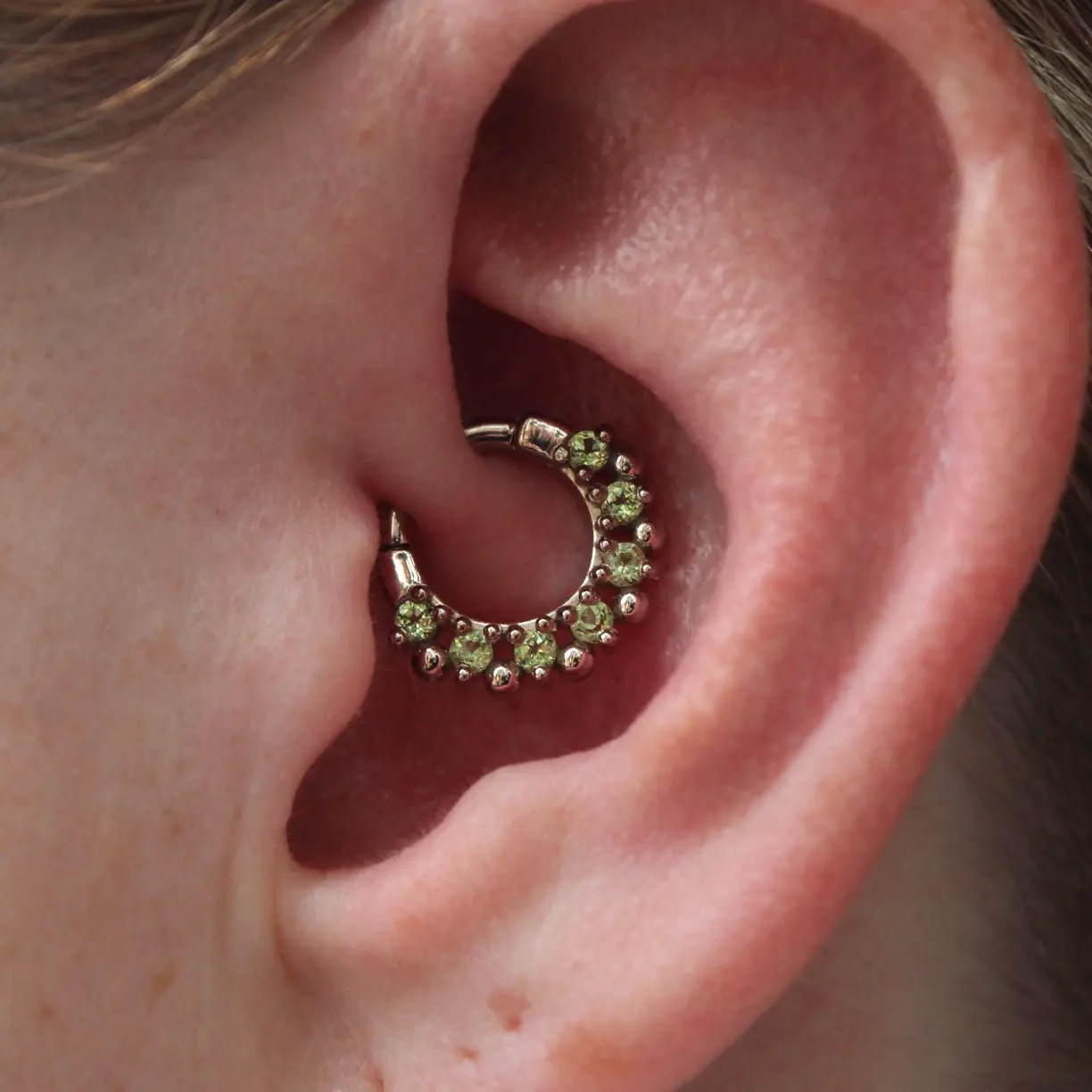
Myth: Will a daith piercing cure my migraines? Fact: No. This is the most common myth about this piercing. There is no scientific or clinical evidence that a daith piercing is an effective treatment for migraines. The American Migraine Foundation does not recommend it as a treatment. The theory is based on a specific acupuncture point, but a piercer is not trained to find this exact point, and any relief reported is widely considered to be a placebo effect.
Myth: It's an ear piercing, so it will heal quickly like my lobes. Fact: False. This is a thick piece of cartilage, not fleshy like a lobe. The healing time is very long, averaging 6 to 9 months, and can easily take a year or more for some people.
Myth: I'll be able to wear AirPods again in a few weeks. Fact: False. You cannot wear any in-ear headphones for the entire 6-9+ month healing period. Even after the piercing is fully healed, some people find their jewelry (especially larger rings) makes earbuds uncomfortable or impossible to wear.
Myth: Irritation bumps ("keloids") are a sign of infection. Fact: False. Small bumps near the piercing are common with cartilage and are typically irritation bumps (hypertrophic scars), not infections. They are usually caused by irritation from touching, snagging, sleeping on the piercing, or improper aftercare. A true infection would involve symptoms like extreme pain, hot-to-the-touch skin, and yellow or green pus. True keloids are a specific genetic disorder and are much rarer.
This is a high-maintenance piercing that heals slowly. The key is to keep it clean, dry, and free from any pressure.
- Don't Touch It: Avoid all touching, twisting, or rotating of the jewelry.
- Wash Simply: Clean 2 times per day with a sterile saline wound wash (0.9% sodium chloride only). Spray the area, let it soak, and rinse with clean, warm water in the shower.
- Keep It Dry: Gently pat the area dry with a clean, disposable paper towel or sterile non-woven gauze. Do not use cloth towels.
- No Earbuds: Do not use in-ear headphones or AirPods for the full healing period.
- Don't Sleep On It: Sleeping on the piercing can cause severe irritation, migration, and even change the angle of the piercing permanently. Use a travel "donut" pillow, sleeping with your ear in the hole.
- Keep It Out of Water: Avoid submerging the piercing in pools, hot tubs, baths, or lakes for the entire healing proce
- Anatomy is Required: This piercing is 100% dependent on your ear's unique shape. A successful daith piercing requires a well-defined, sufficiently thick ridge of cartilage (the crus of the helix) to pierce through. Those with a flat, underdeveloped, or very narrow ridge may not be suitable candidates. An in-person assessment is mandatory.
- A "Blind" Piercing: The daith is tucked inside the ear, making it very difficult for you to see. This "blind" nature makes cleaning more challenging and means irritation or "crusties" can build up unseen. You must be prepared for a more involved aftercare routine.
- The "Headphone" Rule: You cannot wear earbuds, AirPods, or any in-ear listening device for the entire healing period (6-9+ months). These devices introduce bacteria and put pressure on the new piercing, which can lead to irritation, bumps, and healing failure. Over-ear headphones are the only option.
- Fun Fact: The daith piercing was first created in 1992 by piercer Erik Dakota. Its name (pronounced "doth") is said to come from the Hebrew word "da'at," which means "knowledge".
Rook
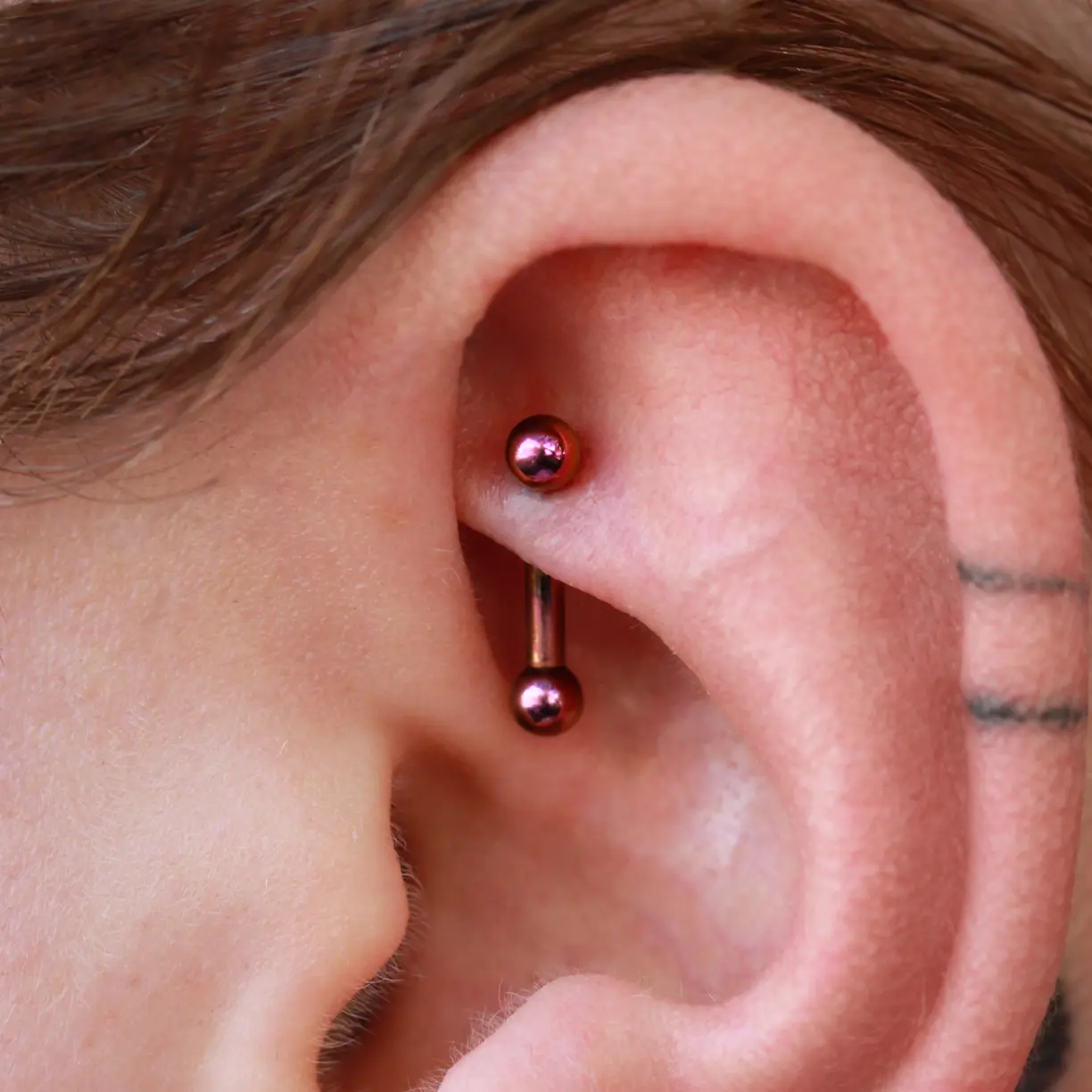
What does it mean that I "don't have the anatomy" for a rook? Fact: The rook piercing is placed through the anti-helix, which is the ridge of cartilage inside the upper ear. In some people, this "shelf" is very pronounced, thick, and well-defined, making it a perfect, stable location for a piercing. In other people, this ridge is flat, thin, or not well-defined. Attempting to pierce a flat or thin ridge would lead to a very high risk of migration and rejection, as the jewellery would not be properly supported by the tissue.
What is a "faux rook"? Fact: A "faux rook" (also known as a flat piercing) is a popular and beautiful alternative for those who cannot get a true rook. It is a flatback stud placed on the "flat" area of cartilage below the rook ridge. When styled with a decorative stud, it gives a very similar aesthetic, is suitable for almost all anatomies, and often heals more easily.
Can I wear earbuds or over-ear headphones? Fact: In-ear earbuds (like AirPods) are not an option during the 6-12 month healing time, as they will put direct pressure on the piercing. Over-ear headphones are generally fine, as the cup rests around the ear and should not put pressure on the rook itself. However, you must be very careful when taking them on and off not to snag the jewellery.
Why does the rook take so long to heal? Fact: Rooks have a reputation for being slow healers for two primary reasons: 1) They are pierced through thick cartilage, which has less blood flow than soft tissue , making the body's healing response slower. 2) Their "tucked" location can make them difficult to clean thoroughly and prone to trapping moisture and debris, which can irritate the piercing and slow down healing.
- on't Touch It: Do not twist, turn, rub, or move the jewellery. Only touch the area with thoroughly washed hands when you are cleaning it.
- Wash Simply: Clean the piercing 2-3 times per day with a sterile saline wound wash (0.9% sodium chloride only).
- Rinse in Shower: Let clean, warm water run over the piercing in the shower to rinse away saline and any softened "crusties." This is the easiest way to clean this hard-to-reach area.
- Keep It Dry: After cleaning, gently pat the area dry with a clean, disposable paper towel or sterile non-woven gauze. Do not use cloth towels.
- Keep It Out of Water: Avoid submerging the piercing in pools, hot tubs, baths, or lakes during the healing process.
- Don't Sleep On It: This is critical for all cartilage piercings. Sleeping on a healing rook will cause irritation, bumps, and can shift the angle of the piercing. Use a travel pillow with a hole in the centre to avoid all pressure.
- Return for a Check-up: Once initial swelling has subsided (around 12 weeks ), you should return for a check-up. Your piercer will assess if a shorter curved barbell is needed to prevent snagging and assist the final healing stages.
- Extremely Anatomy-Dependent: The rook is one of the most anatomy-dependent ear piercings available. A successful rook piercing requires a well-defined "shelf" of cartilage (the anti-helix) that is prominent enough to safely support the jewellery. If this ridge is too thin or flat, the piercing cannot be safely performed.
- In-Person Assessment is Mandatory: Due to the strict anatomical requirement, a consultation is non-negotiable. Your piercer must physically examine your ear to determine if you are a suitable candidate. If your anatomy is not suitable, we will be happy to suggest alternatives with a similar aesthetic, such as a "faux rook".
- No In-Ear Headphones: Like the daith and tragus, you cannot wear in-ear headphones, earbuds, or AirPods during the entire 6-12 month healing period. The earbud itself will press directly on the bottom of the jewellery, causing constant pressure, irritation, and healing complications.
- Specific Jewellery: Unlike most cartilage piercings that start with a straight labret, the rook is pierced with a curved barbell. This shape is necessary to fit the unique anatomy of the cartilage ridge it passes through.
- Long Healing Time: Rooks are "notoriously tricky healers". They are pierced through thick cartilage and are in a tight, "tucked away" space , which can make cleaning difficult. Full healing takes 6-12 months, and consistent, diligent aftercare is mandatory for success.